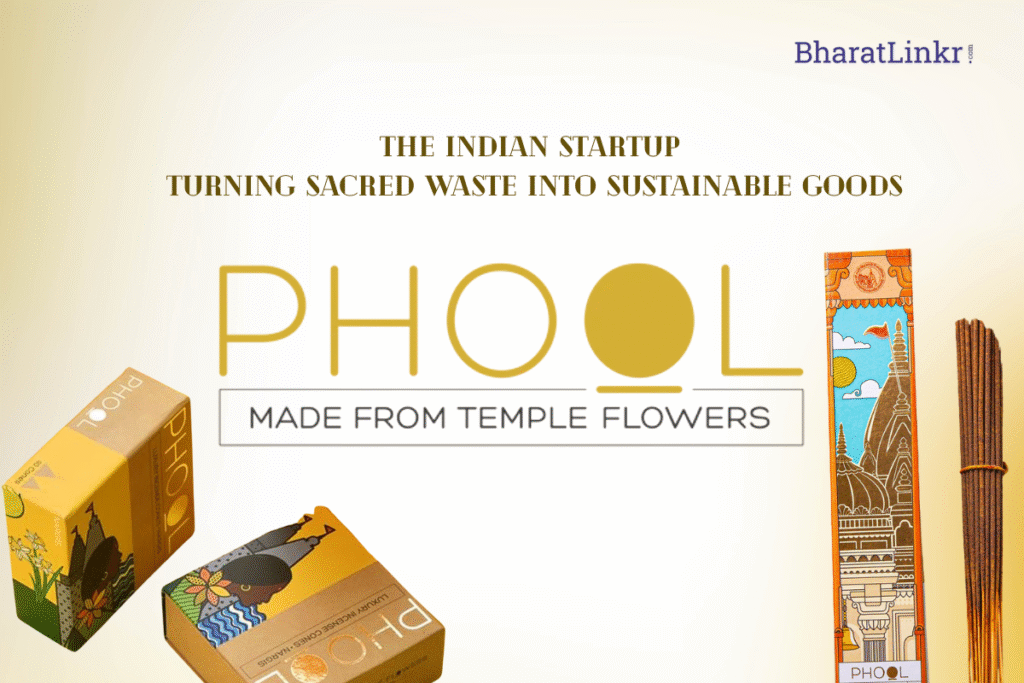
Every day in India, temples and mosques receive a truckload of fresh flowers. These flowers represent the deep spiritual nature of the worshippers. But once the devotion ends, the flowers are dumped in masses in rivers like the Ganges, causing land pollution. The pesticides and chemicals from the flowers mix in the water, affecting the water, fish, and humans.
During India’s famous Makara Sankranti festival, two youngsters, Ankit Agarwal and Prateek Kumar, recognized the impact of the floral waste on the environment. This led to the birth of Phool.co, a startup that now recycles tonnes of flowers each day into incense, compost, and even vegan leather.
A Problem Hiding in Plain Sight
In India, nearly 8 million tonnes of flowers are offered in temples every year. These flowers are tossed into holy rivers like the Ganges—a lovely religious practice that is having a regrettable outcome. As the flowers decompose, they release chemicals from pesticides, including arsenic, lead, and cadmium, into the waterways, causing water pollution. This leads to the growth of algae, which in turn reduces oxygen in the water and can kill aquatic life.

“My friend happened to ask me, if the river is so sacred, why is it so polluted? I had never really questioned any of these practices earlier, and purely out of curiosity, I decided to do some research to see whether we were doing anything about this,” said Ankit, the founder of Phool.co
Giving Offerings a New Purpose
The journey starts early in the morning. Phool’s team visits temples and mosques to collect the flower offerings from the previous day. The flowers are taken to their workshop where women sort them by type and colour. They grind some kind of flowers to make incense sticks and cones. Others are composted into natural fertiliser. But the real breakthrough is Fleather.
Flethear is a plant-based material that looks and feels like animal leather but is completely biodegradable. This innovation has caught the eye of global fashion brands looking for sustainable materials.

Empowering Women, One Job at a Time
Recycling is just one aspect of Phool.co’s activities. It focuses on providing opportunities to those who need them the most. The company employs over 100 women from marginalised communities in Kanpur. Many of them were once ragpickers, laboring in hazardous conditions and receiving irregular pay.
Because of Phil.co, these women have steady salaries, health benefits, and safer workplaces. These women can support their families and communities thanks to Phool’s empowerment approach, which places a strong emphasis on skill development and financial independence.


Earning Trust in Sacred Spaces
One of the biggest hurdles for Phool was gaining the trust of religious leaders. Temples and Mosques often misunderstand the concept of recycling, as the flowers are sacred. Phil’s team spent time meeting with priests and caretakers, explaining how the flowers would be used respectfully. Additionally, they had to spend money on research to make Fleather durable enough to compete with animal leather without sacrificing its environmentally friendly qualities.
“Phool has created several Fleather prototypes thus far, including wallets, sling bags, sandals, and trainers,” Ankit reported to BBC.
What Comes Next
The team at Phool.co is currently looking into ways to increase Fleather production and collaborate with fashion brands. They are also working on new products from temple waste, including biodegradable packaging.

According to Forbes, “Phool is India’s first D2C wellness brand to obtain the coveted Fair for Life-Fairtrade, and Ecocert Organic & Natural certifications.”
Also read | Agnikul Cosmos: India’s First Single-Piece 3D-Printed Rocket Engine and the Future of Space Access