Koo, a made-in-India, desi alternative to Twitter/X?
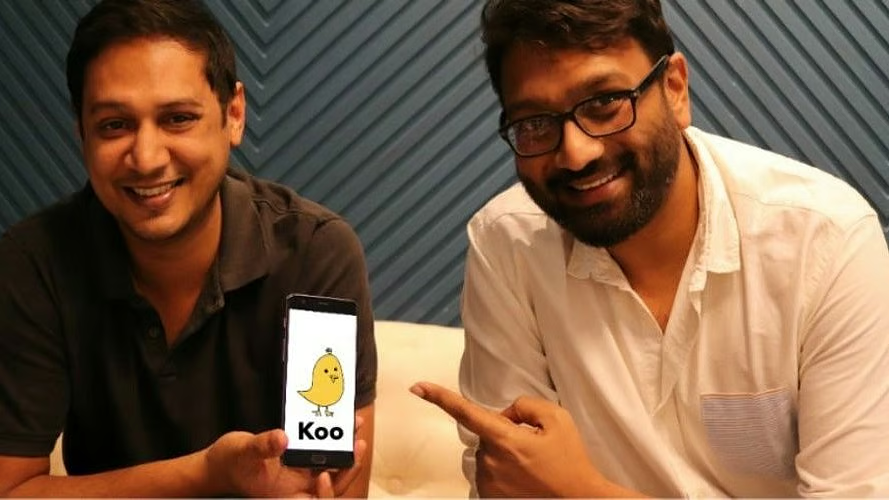
Founders, Aprameya Radhakrishna and Mayank Bidawatka, found a unique way to emotionally connect with Indians, expressing, ”In a world where 80% of the population speaks a language other than English, this is a strong need. We wanted to democratize expression and enable a better way to connect people in their local languages.” During the chaos, when Musk took over Twitter, Koo could have easily captured its audience, but it failed to do so.
What led to the inevitable shutdown of Koo?
Koo, a microblogging platform focusing on regional languages, didn’t resonate with Indians. The founders of Koo realised, ”Social media is probably one of the toughest companies to build, even with all resources available, as you need to grow users to a significant scale before one thinks of revenue.” Initially, after the launch of Koo in 2020, it gave tough competition to Twitter as stated by the founders, “At our peak, we were at about 2.1 million daily active users and ~10 million monthly active users, 9000+ VIPs, that included some of the most eminent personalities from various fields. We were just months away from beating Twitter in India in 2022,” but financial setbacks led to the downfall of Koo. But while the user growth was slow, Koo’s spending and strategic choices further strained its survival prospects.
Was providing a premium marketing strategy necessary?
A hefty amount was disbursed on the promotion and marketing of Koo. While the multilingual approach was a step in the right direction, it was not strong enough to make people switch from a globally recognized platform. Initial investments were from political parties that targeted a niche segment lacking ideological diversity. Koo’s focus remained primarily on the Indian audience, which ultimately limited its reach and led to Koo’s collapse.
Partnership opportunities were also discontinued halfway, as most didn’t want to deal with “user-generated content and the wild nature of a social media company.” Koo also lagged in offering a quality UI/UX experience to the audience, and they aggressively spent almost 28% of total expenses on marketing, higher than the industry norms. Somehow, they managed to collect $60-70 million but fell short in effective cost management. Founders wanted sustainable growth as “Patient, long-term capital is essential to build ambitious, world-beating products from India,” but soon discovered that investors were bidding on short-term growth and that there is a shortage of investors in India.
Out-of-the-box thinking may have saved Koo?
As rightly said by Brian Solis, “Social media is about sociology and psychology more than technology,” founders should have experimented with an innovative platform, generating a user base rather than a mere ‘safe copy.’ The founders had their hard-earned lesson after 5+ years of rigorous efforts, penning down, “As for us, we are entrepreneurs at heart and you will see us back in the arena one way or another.” This should be the spirit of every startup, successful or struggling —failure is just the beginning with more experience. Koo’s fall is a reminder that vision, innovation, and most importantly, emotional connection with the audience, determine whether a startup can thrive in today’s competitive business environment.